Arabic AI voiceover for ads, reels and audiobooks: a production guide for Gulf brands
A 30-second Gulf Arabic spot, a week of reels, a 6-hour audiobook. How agencies and creators produce Arabic voiceover with AI — from casting the voice to the final WAV — and what each minute costs.
nutq teamPublished 3 min read
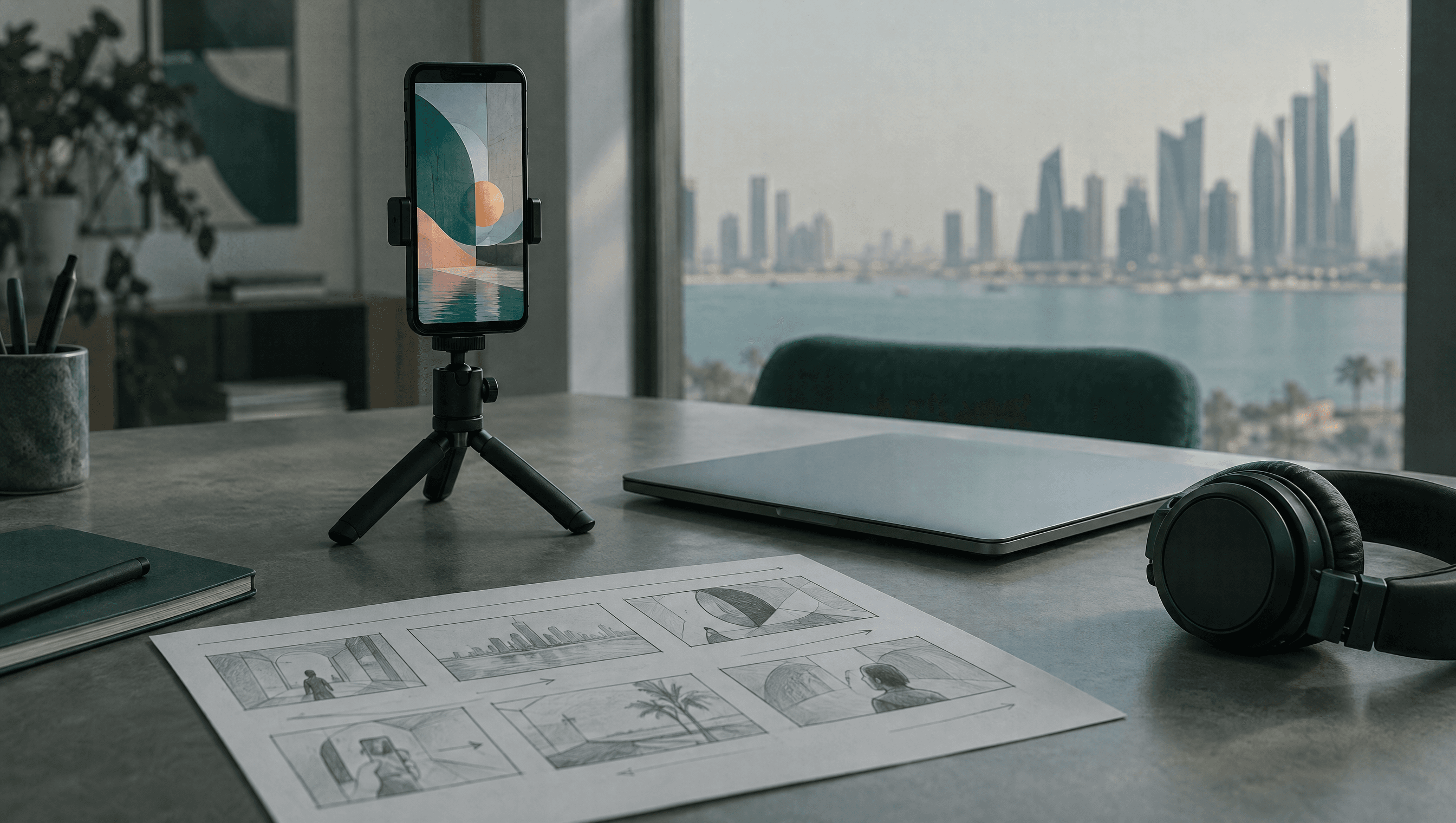
Gulf brands produce more video than ever — reels, TikToks, YouTube pre-rolls, app explainers — and almost all of it needs an Arabic voice. Booking a studio for every variation does not scale. This guide shows how agencies and creators produce Arabic AI voiceover that sounds local: casting, scripting, emotion, timing, and cost.
What can Arabic AI voiceover be used for?
| Format | Typical length | What matters most |
|---|---|---|
| Social ads and reels | 6–30 seconds | Energy, a hook in the first second, exact timing |
| Radio and pre-roll spots | 15–60 seconds | Clear offer, warm close |
| Explainers and onboarding | 1–3 minutes | Clarity, consistent pace |
| IVR and app prompts | A sentence each | One voice across hundreds of lines |
| E-learning | 5–20 minutes per module | Steady, calm delivery |
| Audiobooks and podcasts | Hours | The same voice from chapter one to the end |
How do you cast an Arabic AI voice?
Start from the audience. For an Emirati or Saudi audience, a Gulf voice; nutq has 16, male and female, most of them Emirati, plus Egyptian and MSA voices. Audition two or three on the same line before committing — the voice library lets you hear each one.
If the brand already has a voice — a founder, a presenter, an existing actor — clone it from six to eight seconds of clean speech and save it on the account. Every later generation uses it by name.
How do you write a script that sounds human?
Write in the dialect the listener speaks, then direct it with cues. A 20-second spot:
[excited] جديدنا وصل! [pause:300] قهوة مختصة، محمّصة في دبي، توصلك لين الباب.
[amused] وإذا ما عجبتك؟ [pause:400] [tender] نرجع لك فلوسك، ولا كلمة.
[neutral] اطلب الحين من التطبيق.
- One emotion per beat. The cue applies until the next one.
- Pauses are timing tools.
[pause:300]lets a line land without slowing the whole read. - Product names in English stay English. nutq-speak-3 reads English words inside Arabic as English.
- About 13 characters is one second — write to the length of the cut, not the other way round.
The full list of emotions and sounds, with examples, is in Arabic text to speech with emotion.
How do you produce a dialogue or a drama?
Open each line with the speaker's name, and the request returns one file:
[Sultan] [surprised] شو هذا؟ [pause:500]
[Maitha] [amused] هدية بسيطة [laughter] افتحها!
Each line is generated separately and joined, so it plays as two people reading lines rather than overlapping conversation. That suits ads and scripted drama; for long-form fiction, generate scene by scene and edit as you would a recorded session.
How do you handle long reads like audiobooks?
nutq-speak-3 is built for steadier long reads, so a narrator sounds the same in chapter ten as in chapter one. A practical workflow:
- Split the book into scenes under 5,000 characters each (the per-request limit).
- Keep the same voice and a neutral starting emotion across all scenes.
- Add emotion only where the story turns:
[sad]at a loss,[scared]in suspense. - Listen once at speed; regenerate only the lines that miss. Each take differs slightly, which is useful.
What does it cost?
| Job | Characters (≈13 per second) | Cost at $0.05 per 1,000 |
|---|---|---|
| 15-second reel | ~200 | $0.01 |
| 30-second spot | ~400 | $0.02 |
| 3-minute explainer | ~2,300 | $0.12 |
| 1-hour audiobook | ~47,000 | $2.35 |
Budget for retakes on top. Monthly plans include a commercial licence; check the current terms before running paid media. New accounts start with $5 of credit at sign-up.
Where to produce it
- In the browser: the Arabic text to speech page, or the studio, which also times Arabic captions to the same video.
- In code: one POST to
/v1/speech; see Arabic text to speech with voice cloning. - In automation: Arabic text to speech in n8n for batches of ads or daily content.
Questions people ask
Can AI produce a professional Arabic voiceover?
For many jobs, yes: ads, reels, explainer videos, IVR, e-learning and audiobooks. nutq-speak-3 performs emotions, laughter and pauses in Gulf voices and keeps the voice steady across long reads. For a flagship brand campaign, many teams still use AI for drafts and a human actor for the final.
How much does Arabic AI voiceover cost?
$0.05 per 1,000 characters. A 30-second spot is about 400 characters, roughly two cents; an hour of narration is about 47,000 characters, roughly $2.35 before any retakes.
Can I use the voiceover commercially?
Monthly plans include a commercial licence. Check the plan details on the pricing section of nutq.dev before publishing paid campaigns.
Can I use my own voice or a presenter's voice?
Yes. Clone a voice from six to eight seconds of clean speech, or save it on your account and use it by name. Only clone a voice you have the right to use; nutq asks you to confirm consent when you save one.
How do I time the voiceover to a video?
Write about 13 characters per second of video, use [pause:800]-style cues to hold beats, and adjust the speed parameter between 0.75 and 1.35 for small fixes. For captions on the same video, nutq Studio times them to the audio.
Written by nutq team. nutq is an Arabic speech API built in the UAE: speech to text that keeps Gulf dialect, and Arabic text to speech with voice cloning.
اقرأ بالعربيةHear it on your own audio.
$5 of credit to start — about 33 hours of transcription. No card.
Keep reading
All articles
Guides3 min read
How to make Claude, ChatGPT or Cursor speak and transcribe Arabic (MCP)
Your AI assistant can write an Arabic script, but it cannot say it — or listen to your Arabic voice note. Connect one MCP server and it can do both, in Gulf dialect, from the chat.

Guides3 min read
How to build a Gulf Arabic voice agent with Vapi
Most voice-agent stacks fall over the moment a caller speaks Gulf Arabic. Two blocks of Vapi configuration fix both ends of the call — hearing the caller and answering them.
Text to speech3 min read
Arabic text to speech with emotion: make an AI voice laugh, sigh and change mood mid-line
Most Arabic AI voices have one mood: polite. nutq-speak-3 can be excited, amused, tender or angry — and switch between them inside a sentence — because you write the emotion into the script.