How to use subtitled videos to boost Arabic vocabulary, with Gulf clips you make yourself
Subtitled video gives you the sound, the spelling and the situation of a word at once. The hard part for Gulf Arabic is finding clips at your level, so make them: a short dialogue, two voices with real emotion, and captions timed to the speech.
nutq teamPublished 4 min read
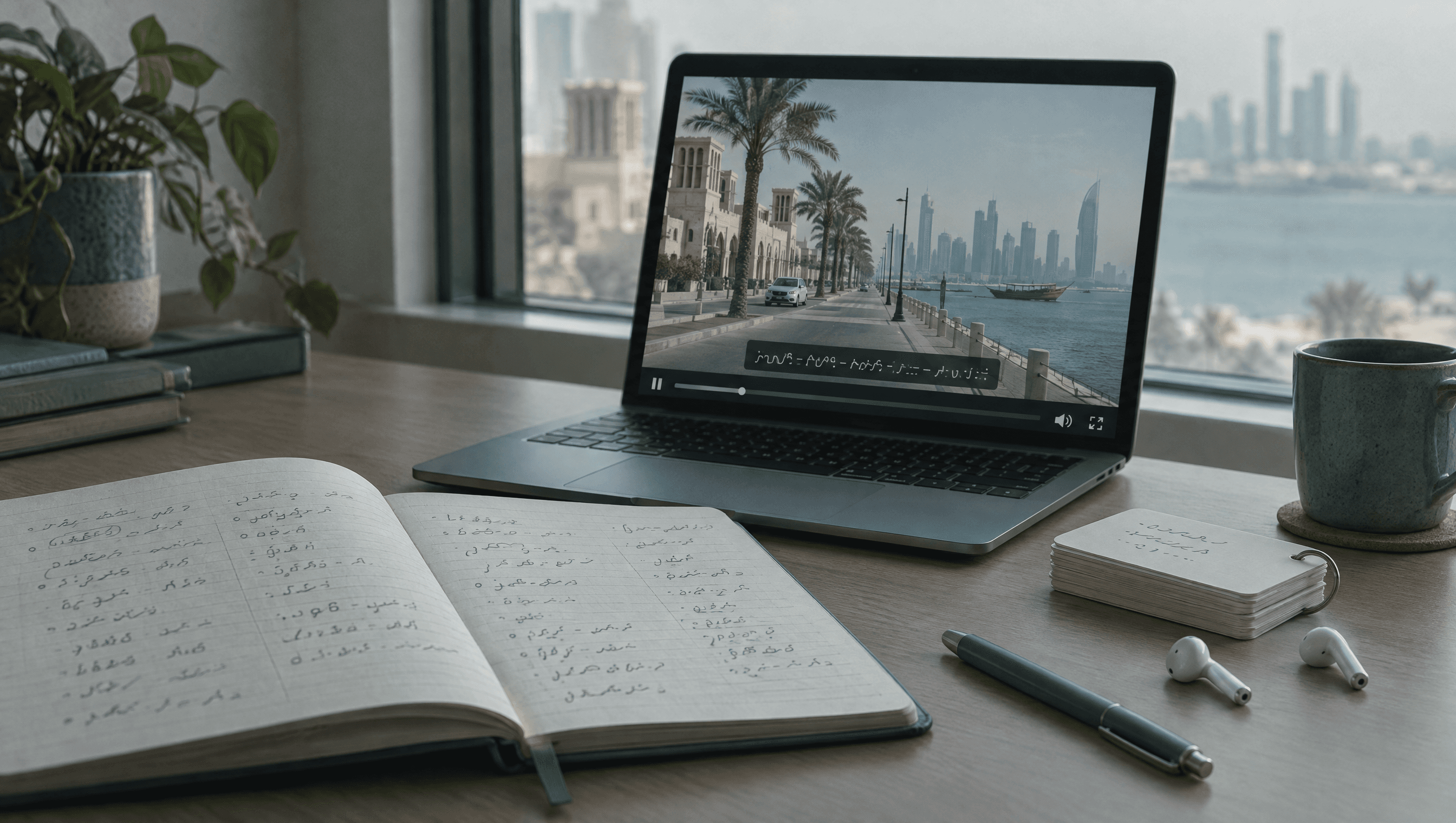
Learners keep asking how to use subtitled videos to boost Arabic vocabulary, and the short answer is: watch less, more often, with a plan. A subtitled clip gives you three things at once: the sound of a word, its spelling, and the situation it is used in. The trouble with Gulf Arabic is finding clips at your level. Most material is either Modern Standard Arabic news or native-speed TV. This guide covers the method, then how to make your own clips in Gulf dialect, with voices that sound surprised, annoyed or amused the way real people do.
Why do subtitled videos help Arabic vocabulary stick?
A word you meet in a list is one fact. A word you hear in a scene comes with a voice, a face of the situation and the words around it. Subtitles connect that sound to a written form, which matters in Arabic because short vowels are usually not written, and dialect words often have no fixed spelling in textbooks.
Short clips work better than long ones. One minute you can replay five times teaches more than an episode you watch once. That is the whole trick of learning Arabic with subtitles: the same short scene, seen and heard until the new words feel familiar.
What is the best way to watch a subtitled clip?
Use four passes on the same clip of 30 to 90 seconds:
- No subtitles. Catch what you can. Note where you get lost.
- Arabic subtitles. Match the sounds to the words. Pause on each new word.
- English subtitles. Check the meaning, then switch the translation off again.
- Shadowing. Play line by line and repeat each one aloud, copying the tune, not just the words.
Then write five new words in a notebook or flashcard app, each with the full sentence it came in, and review them the next day, three days later and a week later.
Why does emotion matter for Arabic learners?
Because in spoken Arabic the tune changes the meaning. «صج؟» can be genuine surprise, doubt or teasing. «يا حبيبي» can be warm or exasperated. A learner who only hears a flat, careful voice never learns those tunes, and then misreads them in real conversation.
nutq-speak-3 lets you hear the difference on purpose. Generate the same line in three emotions and play them side by side:
[Alia] [surprised] صج؟ بتسافر باجر؟
[Alia] [sad] صج؟ بتسافر باجر؟
[Alia] [amused] صج؟ بتسافر باجر؟ [laughter]
How do you make your own Gulf Arabic listening clips?
- Write a short dialogue at your level. Pick 8 to 12 target words and use each one at least twice.
- Voice it with two voices. Open each line with the voice's name and mark the feeling where it changes.
- Slow it down if needed. Add
[pause:800]between lines, or setspeedto 0.85 when you generate. - Caption it. In nutq Studio, put the audio over a still image or your own video and choose Generate captions. Captions keep Gulf words as spoken instead of rewriting them in fusha.
- Add a translation. Translate the captions into English or one of the other supported languages, then export an MP4 with captions burned in, or an SRT file for your video player.
A beginner dialogue at a café:
[Sultan] [amused] هلا والله! شحالك؟ [pause:600]
[Maitha] [excited] بخير الحمدلله! أبي كرك وايد حلو. [pause:600]
[Sultan] [surprised] وايد حلو؟ زين، [pause:400] تبين ماي بعد؟
[Maitha] [tender] لا مشكور. الحين بس الكرك.
And the words it teaches:
| Gulf | Modern Standard | English |
|---|---|---|
| شحالك؟ | كيف حالك؟ | How are you? |
| أبي | أريد | I want |
| وايد | كثيرًا | very, a lot |
| زين | جيد | good, okay |
| تبين | تريدين | you want (to a woman) |
| ماي | ماء | water |
| الحين | الآن | now |
| باجر | غدًا | tomorrow |
For more on how Gulf words differ from their textbook forms, see Gulf Arabic vs MSA.
Can teachers use this in class?
Yes, and it solves the problem most Arabic teachers have: the dialogue in the book never quite matches the lesson. Write the clip for this week's words, give the two characters different voices, and play each emotion version to start a discussion about what the speaker meant. Teachers of Modern Standard Arabic can do the same with fusha text. For young learners, a short story with a narrator and two characters works the same way; see Arabic bedtime stories for kids. For a whole course you publish or sell, the monthly plans include a commercial licence.
What does it cost?
A one-minute dialogue is about 800 characters, roughly 4 cents at $0.05 per 1,000 characters, and pauses are free. Captions are $0.15 per hour of audio. The $5 of credit at sign-up is enough for dozens of clips.
Start by hearing the voices on the Arabic AI voice generator page, then read how to add Arabic subtitles to a video automatically for the captioning step in detail.
Questions people ask
Should I watch Arabic videos with Arabic or English subtitles?
Both, in order. Arabic subtitles connect the sound of a word to its spelling; a translation confirms the meaning. Watching the same clip first without subtitles, then with Arabic, then with the translation, gives each its job.
Where can I find Gulf Arabic videos for learners?
There are few, and most are either Modern Standard Arabic or native-speed TV. You can make your own: write a short dialogue at your level, voice it in Gulf Arabic with two AI voices, and add captions that keep the dialect as spoken.
Why does emotion matter when learning Arabic?
Because intonation carries meaning. The same «صج؟» can be surprised, doubtful or teasing, and learners need to hear the difference. nutq-speak-3 can read one line in several emotions so you can compare them side by side.
Can I slow the audio down for beginners?
Yes. Write pauses between lines with cues such as [pause:800], and set the speed parameter below 1, for example 0.85, when you generate the clip.
What does a homemade clip cost?
A one-minute dialogue is about 800 characters, roughly 4 cents of speech at $0.05 per 1,000 characters. Captions are $0.15 per hour of audio, so a fraction of a cent. New accounts start with $5 of credit.
Written by nutq team. nutq is an Arabic speech API built in the UAE: speech to text that keeps Gulf dialect, and Arabic text to speech with voice cloning.
اقرأ بالعربيةHear it on your own audio.
$5 of credit to start — about 33 hours of transcription. No card.
Keep reading
All articles
Guides3 min read
Arabic AI voiceover for ads, reels and audiobooks: a production guide for Gulf brands
A 30-second Gulf Arabic spot, a week of reels, a 6-hour audiobook. How agencies and creators produce Arabic voiceover with AI — from casting the voice to the final WAV — and what each minute costs.
Guides3 min read
How to make Claude, ChatGPT or Cursor speak and transcribe Arabic (MCP)
Your AI assistant can write an Arabic script, but it cannot say it — or listen to your Arabic voice note. Connect one MCP server and it can do both, in Gulf dialect, from the chat.

Guides3 min read
How to build a Gulf Arabic voice agent with Vapi
Most voice-agent stacks fall over the moment a caller speaks Gulf Arabic. Two blocks of Vapi configuration fix both ends of the call — hearing the caller and answering them.